Finance should own sustainability reporting because ASRS treats emissions disclosure as regulated financial reporting. It demands the same accuracy, auditability, completeness, and control that Finance teams already apply to financial statements.
Climate reporting is no longer on the horizon. Under the Australian Sustainability Reporting Standards (ASRS), Group 1 entities (those meeting at least two of three thresholds: more than 500 employees, A$500 million or more in consolidated revenue, or A$1 billion or more in consolidated gross assets, plus NGER reporters) must disclose emissions for financial years starting on or after 1 January 2025. Group 2 entities follow from 1 July 2026, and Group 3 from 1 July 2027.
For Finance teams, this is an extension of core responsibilities, not a new function to build from scratch.
Why is carbon reporting now considered financial reporting?
The ASRS is based on the ISSB's IFRS S2 standard, which aligns closely with the GHG Protocol. It requires companies to report emissions using consistent reporting boundaries, document all data sources and estimation methods, and provide disclosures that can withstand audit scrutiny.
These requirements mirror how financial statements are prepared and assured. Sustainability reporting is no longer a separate exercise led by sustainability teams: it's now part of regulated corporate disclosure, sitting alongside the annual report.
For finance professionals, this should feel familiar. You already own the systems and controls that can support this kind of reporting. Trying to bolt sustainability data onto the side of the business, disconnected from your financial systems, doesn't work, especially when audit requirements come into play.
Why are Scope 3 emissions a general ledger exercise?
One of the biggest challenges in sustainability reporting is Scope 3 emissions: the indirect emissions from upstream suppliers and downstream customers. The GHG Protocol defines 15 standard Scope 3 categories:
At their core, most of these categories map directly to how your business spends money. The general ledger is the best starting point: it's structured, it's complete, and it already reflects your reporting boundary.
How do you calculate Scope 3 emissions from the general ledger?
- Start with the general ledger: exclude irrelevant accounts and identify emissions-relevant spend.
- Categorise accounts using standard Scope 1, 2, and 3 categories aligned with the GHG Protocol.
- Apply emissions factors from reliable databases (e.g., National Greenhouse Accounts, IELab, DEFRA).
- Source activity data (e.g., electricity bills, fuel invoices, travel reports) for higher-accuracy categories.
- Reconcile spend and activity data to check for completeness.
- Document everything in a "basis of preparation" that auditors can follow.
This is very similar to how Finance already handles cost allocation or indirect tax mapping. The process is analytical, data-driven, and traceable, and it relies on systems that Finance already owns.
Does ASRS require third-party assurance?
Yes, and it escalates over time rather than applying in full from day one. In year 1, limited assurance covers governance and strategy/risk disclosures plus Scope 1 and 2 emissions. By year 2, Scope 1 and 2 move toward reasonable assurance while Scope 3 receives limited assurance. From 1 July 2030, the Auditing and Assurance Standards Board (AUASB) requires reasonable assurance across all climate disclosures under the Corporations Act.
That means your carbon data needs to be treated with the same rigour as your financials well before assurance requirements peak. Auditors will expect to see:
- A clear basis of preparation
- Evidence for how data was collected or estimated
- Justification for assumptions and exclusions
- Reconciliation between emissions estimates and financial records
This isn't something that can be handled in a standalone spreadsheet by a single sustainability lead. It requires a controlled, repeatable process that aligns with existing financial governance practices.
What's the difference between Finance's role and the sustainability team's role?
Sustainability teams remain essential, but their role shifts under ASRS.
When Finance leads the data and controls side of the process, and sustainability guides strategy and context, the result is stronger, more reliable reporting, and fewer gaps when audit season rolls around.
Can spreadsheets handle sustainability reporting long-term?
Spreadsheets can get many organisations through a first-time inventory. But as reporting becomes annual, and assurance is introduced, their limitations show up quickly: version control, data integrity, and audit trail management become difficult to manage at scale.
Purpose-built carbon accounting software addresses this by:
- Integrating directly with your GL
- Categorising spend into GHG Protocol-aligned categories using AI
- Matching activity data with appropriate emissions factors
- Extracting consumption data automatically from fuel and energy invoices
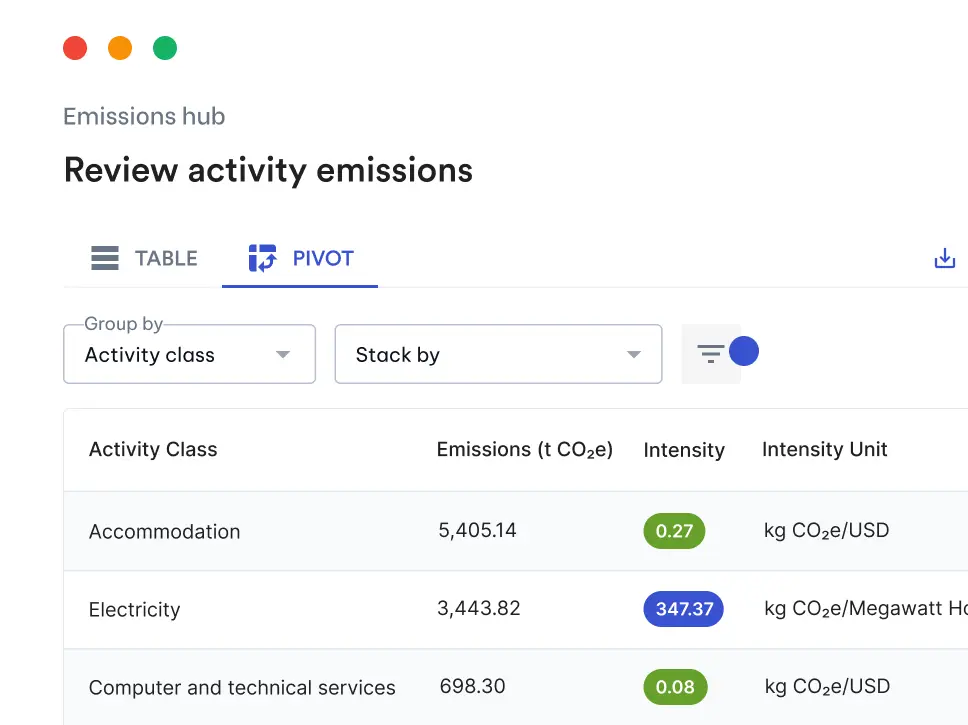
- Maintaining a documented calculation trail for auditors
A system like Avarni helps Finance teams move from a manual, spreadsheet-based approach to a structured, audit-ready process. Spreadsheets might be a reasonable starting point, but adopting software early keeps the methodology consistent, the data accessible, and visibility shared across the business.
Who is ultimately accountable for sustainability disclosures under ASRS?
Finance. Finance teams are already accountable for what goes into the annual report. As emissions data becomes part of that disclosure, Finance needs to bring sustainability reporting into the fold, applying the same discipline, process, and standards it already uses for financial statements. You don't need to be climate experts, but you do need to own the reporting process.
FAQ
What is Scope 3 emissions reporting?
Scope 3 covers indirect emissions across a company's value chain: 15 categories defined by the GHG Protocol, spanning purchased goods, business travel, and use of sold products, among others. For most companies, Scope 3 represents the majority of total emissions.
Does ASRS apply to my company?
ASRS applies in three phases based on size. Group 1 entities (500+ employees, A$500m+ revenue, or A$1bn+ assets, meeting two of three criteria, or NGER reporters) report from financial years starting 1 January 2025. Group 2 follows from 1 July 2026, and Group 3 from 1 July 2027.
Is Scope 3 reporting mandatory in year one?
No. Scope 3 disclosure is optional in an entity's first reporting year and becomes mandatory from the second reporting period onward.
What level of assurance does ASRS require?
Assurance escalates: limited assurance over governance, strategy, and Scope 1/2 in year 1; limited assurance over the full report by years 2–3; and reasonable assurance over all disclosures from 1 July 2030.
Can Finance own sustainability reporting without climate expertise?
Yes. Finance doesn't need deep climate science expertise; it needs to own the data, controls, and audit-readiness process, while sustainability teams provide subject-matter input on materiality and strategy.
Summary
- ASRS brings emissions reporting into the scope of regulated financial disclosure, phased in by size from 2025–2027.
- Finance teams are best equipped to lead the process, given their control over systems, data, and audit readiness.
- Scope 3 emissions span 15 GHG Protocol categories and can be estimated using general ledger data through a repeatable, traceable process.
- Assurance requirements escalate from limited to reasonable, reaching full reasonable assurance by 1 July 2030. This requires documented methodologies and reconciliation that Finance already manages.
- Sustainability teams still play a critical role in materiality and strategy, but disclosure ownership needs to live within Finance.
- Spreadsheets are a starting point, not a scalable solution; purpose-built software supports audit readiness and process control.
- Finance doesn't need to become sustainability experts, but it does need to own the reporting process.
Originally published: Nov 26, 2025