Compare the best carbon accounting software in Australia for 2026. See how Avarni and other sustainability reporting solutions support the Australian Sustainability Reporting Standards (ASRS), the Greenhouse Gas (GHG) Protocol, and other key reporting frameworks.
As regulatory pressure increases and corporate climate targets become more ambitious, Australian businesses are adopting carbon accounting software to streamline emissions measurement, reporting, and reduction. But with so many platforms now available, ranging from fully automated Scope 3 systems to disclosure tools aimed at investors, choosing the right one can get complicated, fast.
This guide cuts through the noise. As of September 2026, we reviewed nine software platforms based in Australia or actively serving the Australian market, assessing how each handles emissions data, compliance with reporting standards (ASRS, GHG Protocol, ISSB), data collection methods, and real-world usability. Our review is based on vendor product documentation, public regulatory guidance, and direct platform enquiries, and we've listed the specific standards and integrations each platform supports so you can compare them against your own requirements.
Australia's climate reporting requirements at a glance
The Australian Sustainability Reporting Standards (ASRS), including AASB S2, are being phased in from 1 January 2025 and will eventually apply to more than 6,000 companies. Entities are grouped by size, based on meeting at least two of three thresholds:
- Group 1 reports from their first reporting period on or after 1 January 2025: $500 million or more in consolidated revenue, $1 billion or more in gross assets, or 500 or more employees (this group also includes NGER reporters regardless of size).
- Group 2 reports from 1 July 2026: $200 million or more in revenue, $500 million or more in assets, or 250 or more employees.
- Group 3 reports from 1 July 2027: $50 million or more in revenue, $25 million or more in assets, or 100 or more employees.
Scope 3 emissions reporting is required from each group's second reporting year. Separately, the Safeguard Mechanism requires facilities emitting more than 100,000 tonnes of CO2-e a year to keep emissions within declining baselines. Facilities that exceed their baseline face a penalty of one penalty unit per tonne of excess CO2-e, plus a continuing penalty of 100 units for each day the excess remains unaddressed within a two-year window. As at 1 April 2025, a penalty unit is worth $330.
Selecting the right carbon accounting platform is a strategic decision that shapes your compliance risk, audit costs, and ability to act on reduction targets. The right platform should offer audit-ready data, strong automation, integration with your existing business systems, and genuine Scope 3 and supplier engagement capability.
Why choose an Australian carbon accounting platform?
Choosing an Australian carbon accounting platform can give your business a practical edge. Local providers better understand the Australian Sustainability Reporting Standards (ASRS), evolving regulatory expectations, and the local operational context, from national emissions factors to procurement data. Local support also often means faster response times, better alignment with the Australian financial year, and deeper knowledge of Australian industries and supply chains.
If you need credible, audit-ready reporting for Australia, choosing a platform designed for the region can reduce compliance risk and simplify audits.
1. Avarni
Avarni is an Australian carbon accounting software company, founded in 2021 by former Atlassian and Macquarie Telecom Group staff Misha Cajic and Anuj Paudel, and backed by Main Sequence Ventures (co-founded by CSIRO). Named a Sustainability Leader by the Australian Financial Review in 2023 and 2026, holding SOC 2 Type II certification, and rated 5 stars on G2, the platform is purpose-built for CFOs and finance teams in Australia implementing sustainability reporting. Avarni focuses on carbon accounting, particularly Scope 3 emissions, and supports organisations across Group 1-3 under ASRS reporting requirements.
Regulatory coverage: AASB S2, GHG Protocol.
Automation and compliance at scale
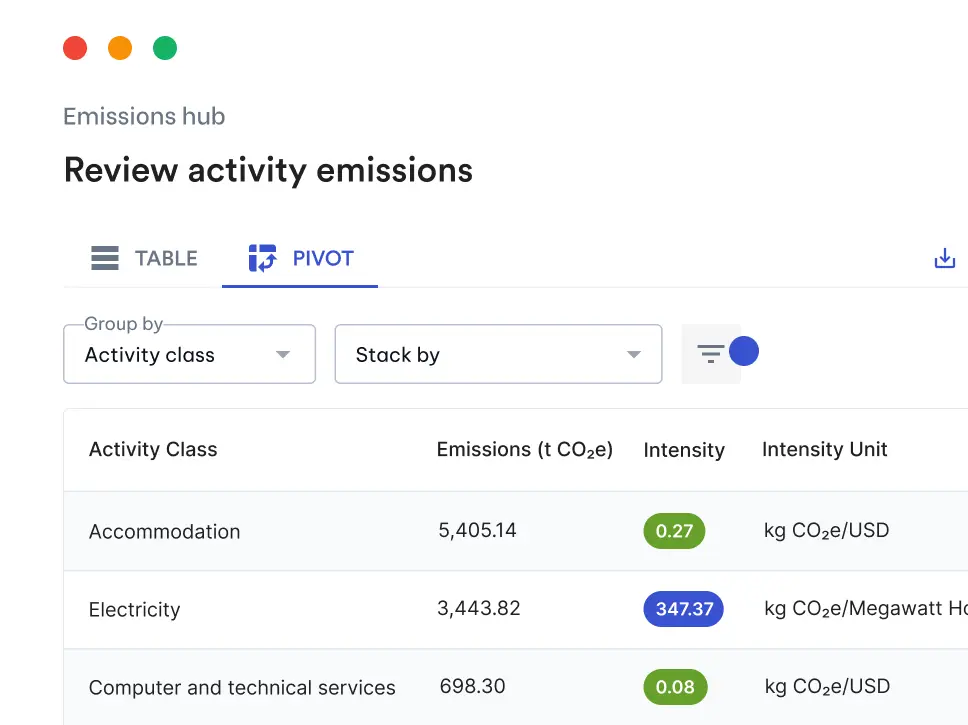
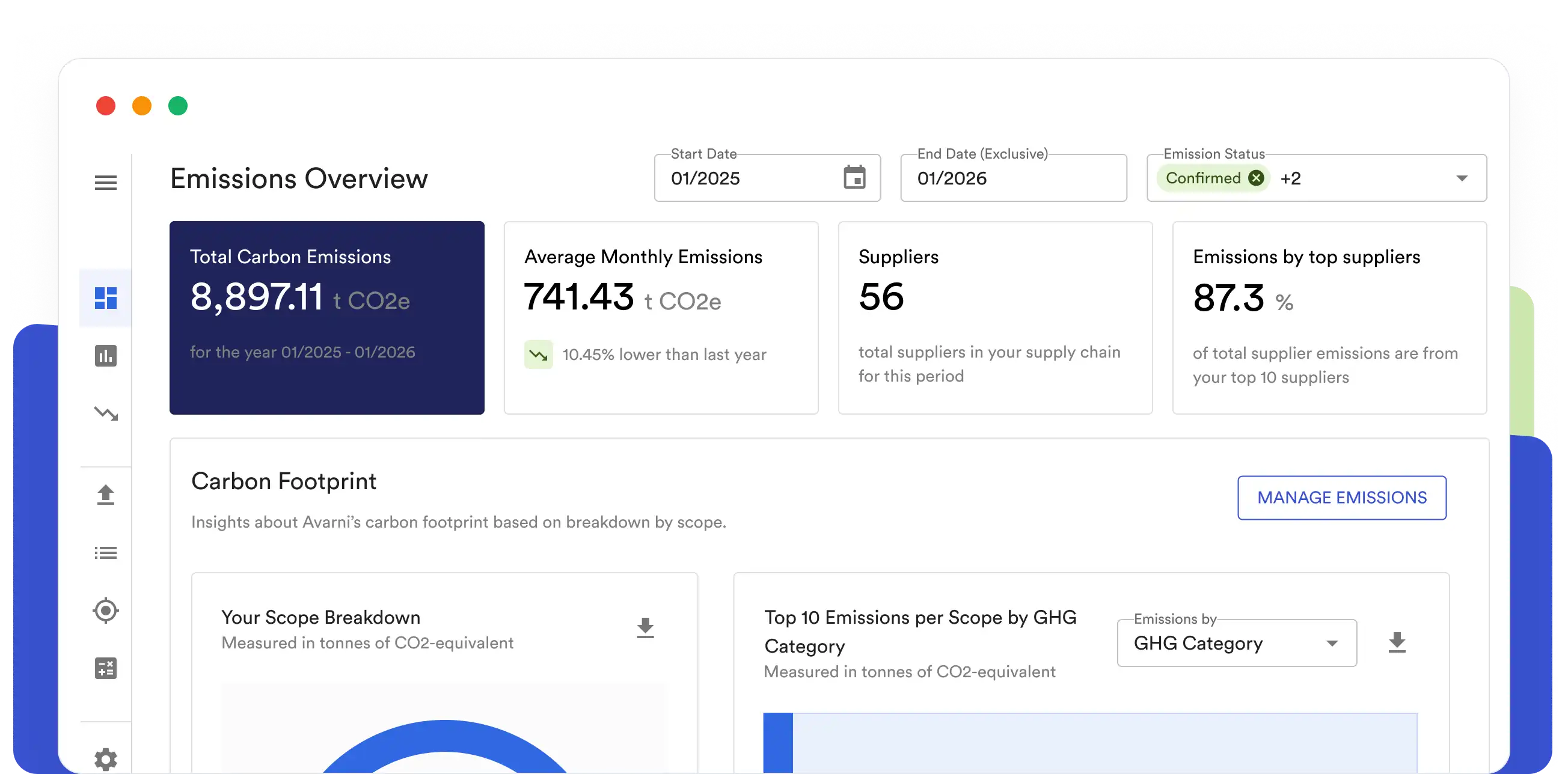
Avarni uses machine learning to automate emissions calculations for Scope 1-3, extract invoice and financial data, and apply emissions factors, reducing manual effort and errors. The platform draws on a library of 65,000+ emission factors, is built to handle large datasets (including millions of rows), enforces consistent calculation rules, and generates audit-ready reports aligned with the Greenhouse Gas (GHG) Protocol, ASRS, and ISSB. It integrates with more than 1,000 enterprise systems, including SAP, NetSuite, Xero, Microsoft Dynamics 365, Workday, and Power BI.
Scope 3 and supplier engagement
Avarni combines Scope 3 analysis with supplier engagement tools for collecting activity-based data directly from suppliers. Where supplier data is missing, it uses spend-based estimates and regional emissions factors to fill gaps and improve verifiability. The platform also provides scenario and forecasting tools to model emissions-reduction pathways against Australia's interim (2035) and net-zero (2050) targets.
Hands-on support
Every Avarni customer is assigned a dedicated implementation team that works directly with their data, in whatever form it exists, to configure the platform around their organisation's specific operations. The onboarding process is structured around teaching internal teams best practice, with the aim of building in-house capability rather than ongoing reliance on external consultants.
Avarni builds audit evidence into the reporting process from the outset. Classification rules record the rationale behind each emissions category, and calculation breakdowns trace the path from raw data to final figures. Auditors can be engaged during implementation to review methodology before the formal assurance process begins. To date, every client submission has cleared external assurance on the first attempt.
For organisations requiring additional ESG or technical advisory support, Avarni maintains partnerships with BDO Australia, Jacobs, NTT Data, and Schneider Electric.
Testimonials from Avarni customers
"Avarni makes it easy for companies that have little experience in calculating and reporting emissions to work towards complying with AASB S2. They have a well-structured process and provide great support to ensure you get the outcome that you are looking for." — Jack Duffy, Head of Finance, Marubeni-Itochu Tubulars Oceania
"I've been really blown away with the level of support that we've got from Avarni. When you think software, you often think no live support, no real person behind that software. And that's not been the case with Avarni." — Jacquie Sharples, Head of ESG, 99 Bikes / Pedal Group
"Avarni offered an ability to reduce this manual labor data extraction element that we hadn't really seen before... the ability to automate our invoices with our own ERP system was by far the biggest selling point for us." — Christopher Carter, Manager of Communications and Sustainability, Green by Nature
"Avarni has delivered substantial value through improved efficiency, stronger data visibility, and simpler compliance management. We would highly recommend the platform to organisations looking for a modern, reliable, and scalable emissions management solution." — Richard Mason, Principal Sustainability and Environmental Specialist, Cement Australia
"Avarni has greatly improved the way we track and report carbon emissions. It streamlines carbon accounting by translating activity data into clear Scope 1, 2, and 3 emissions estimates. This has enabled COG to establish a robust emissions baseline, enhance data consistency, and produce audit-ready reports aligned with standards such as AASB S2." — Mohammad Rahman, Project and Finance Manager - IT Systems, COG Financial
2. Clear Carbon
Clear Carbon is an Australian platform that combines carbon accounting software with advisory services. It supports GHG Protocol alignment and helps businesses build emissions inventories that align with current reporting requirements, covering direct (Scope 1) and indirect (Scope 2 and 3) emissions across air, land, and water. The platform may suit organisations that prefer a guided implementation approach, particularly where internal sustainability resources are limited.
Regulatory coverage: CDP, GHG Protocol, GRI, IFRS, NGER, SBTi, TCFD.
Technical specifications: Draws on 50,000+ emission factors, collects granular data from sensors, IoT devices, and operational systems, and pairs recording and reporting with decarbonisation strategy design and reduction simulation.
3. Climate Zero
Climate Zero is designed for medium to large enterprises navigating mandatory climate reporting. It supports Scopes 1, 2, and 3 and includes features for forecasting and emissions planning, with automated data collection configured to a business's structure and asset needs.
Regulatory coverage: AASB S2, GHG Protocol.
Technical specifications: Automated Scope 1-3 reporting with intuitive dashboards for emissions hotspots, plus supplier engagement tools to bring Scope 3 data into view.
4. Greenbase
Greenbase has a long-standing presence in Australia's carbon reporting space, with more than 25 years providing environmental accounting and reporting services across mining, energy, and utilities. Its Envago platform supports detailed emissions calculation and compliance reporting, including NGER and Safeguard Mechanism tracking, for over 200 of Australia's largest mine sites. It may be most relevant for organisations with complex regulatory obligations and established environmental reporting processes.
Regulatory coverage: GHG Protocol, GRI, NGER, IFRS, NPI, SASB, SICS.
Technical specifications: Lodgement-ready NGER reporting with automated legislative updates and factors, peer benchmarking, and API options for organisations with local facilities and international subsidiaries.
5. NetNada
NetNada offers a streamlined carbon accounting tool for small and medium-sized businesses. It supports both activity-based and spend-based methods and includes built-in climate action planning. The platform is designed for ease of use and quick implementation, with automated mapping of transactions to GHG Protocol scopes and categories.
Regulatory coverage: AASB S2, CDP, Climate Active, NGER, ISSB, SBTi.
Technical specifications: Native, Xero-certified API integrations with Xero, MYOB, and QuickBooks, with daily transaction sync and automatic categorisation.
6. Pathzero
Pathzero now focuses on the financial sector, connecting asset owners, fund managers, and reporting entities through a secure emissions-data network covering more than 200 fund managers and 10,000 unlisted assets. It enables users to assess emissions exposure across investment portfolios using data shared by portfolio companies, and plays a growing role in financed emissions transparency and investor reporting.
Regulatory coverage: AASB S2, GHG Protocol, ISSB, PCAF.
Technical specifications: Pathzero Navigator for PCAF-aligned financed emissions modelling at fund and portfolio level, Pathzero Clarity for corporate disclosures, and a secure Emissions Library for multi-party data sharing.
7. Sumday
Sumday is a carbon accounting platform built for accountants, advisors, and finance teams supporting clients through emissions reporting. It integrates with financial workflows, including a global partnership with Xero, and helps facilitate the collection of Scope 3 data from suppliers. Sumday is particularly relevant for firms providing climate reporting services, rather than large enterprises looking to manage emissions directly within their own operations.
Regulatory coverage: Audit-focused, built around financial accounting workflows rather than a specific disclosure standard.
Technical specifications: Carbon ledger that reconciles with the general ledger, native Xero integration for transaction-level data import, and AI-powered coding suggestions for emission sources.
8. Trace
Trace offers a carbon accounting and climate reporting platform paired with advisory support, covering Scope 1, 2 and 3 emissions, climate risk assessment and ASRS disclosure drafting. Plans are modular, with AI mapping, transaction-level mapping and multi-entity support available on the Enterprise tier, and audit trail, basis of preparation and employee engagement sold as upgrades or add-ons. Trace also offers carbon offsets, Net Zero certification and B Corp accreditation. Its only documented accounting integration is Xero, with data from any other system uploaded as a spend CSV file, and Trace does not publish a security page or independent certification such as SOC 2 Type II or ISO 27001.
Regulatory coverage: AASB S2, ISSB IFRS S2, UK SRS, SECR, GHG Protocol.
Technical specifications: Xero integration, CSV spend upload, invoice OCR, AI transaction mapping, employee engagement surveys, target setting.
9. Workiva Carbon
Workiva Carbon is part of the broader Workiva reporting platform, combining carbon measurement with financial and ESG disclosures. While not developed specifically for the Australian market, it supports international frameworks such as the GHG Protocol and ISSB, and is used by organisations operating across multiple regions and jurisdictions.
Regulatory coverage: GHG Protocol, ISSB (IFRS S1 & S2), ESRS, GRI, SASB, TCFD, CDP.
Technical specifications: Emission factors across 240+ countries and regions, with carbon, ESG, and financial data sharing one governed model and audit trail rather than separate systems.
Frequently asked questions
What are the ASRS reporting deadlines for Group 1, 2 and 3 entities?
Group 1 entities, including large companies and NGER reporters, must report from their first reporting period on or after 1 January 2025. Group 2 entities begin from 1 July 2026, and Group 3 entities from 1 July 2027. Scope 3 emissions reporting is required from each group's second reporting year.
What happens if a business doesn't comply with the Safeguard Mechanism?
Facilities that exceed their emissions baseline face a civil penalty of one penalty unit for every tonne of CO2-e over the limit, plus a continuing penalty of 100 units for each day the excess remains unaddressed within a two-year window. As at 1 April 2025, a penalty unit is worth $330.
What's the difference between spend-based and activity-based emissions data?
Activity-based data uses real quantities, such as litres of fuel or kilowatt-hours of electricity, matched to specific emission factors, and generally produces more accurate results. Spend-based data estimates emissions from the dollar value of a transaction, using industry-average factors. Most platforms, including Avarni, use activity-based data where it's available and fall back to spend-based estimates to fill gaps.
Do all carbon accounting platforms support Scope 3 reporting?
No. Some platforms are built primarily around Scope 1 and 2 or specific niches like advisory workflows, while others, like Avarni, offer dedicated Scope 3 supplier engagement and category-level calculation. Since Scope 3 typically makes up the majority of an organisation's footprint, it's worth confirming the depth of Scope 3 support before choosing a platform.
Related articles
Scope 3 under the ASRS: what Group 1 reporters need to prepare for now
Why most companies get Scope 3 calculations wrong — and how to get it right
This article was originally published Sep 19, 2025