Australia's mining sector is under increasing pressure to demonstrate climate action and transparency. Investors, regulators and downstream customers are demanding credible decarbonisation plans, backed by clear data.
With the Australian Sustainability Reporting Standards (ASRS) now in effect, mining companies must disclose climate-related risks, emissions and transition plans, with more rigour and scrutiny than before.
For companies that prepare early, ASRS reporting is a chance to get ahead of market expectations, de-risk operations and secure long-term growth. The key is knowing where your emissions are, how to reduce them, and how to communicate this effectively.
Key takeaways
- ASRS (AASB S2) requires mining companies to disclose Scope 1, 2 and 3 emissions, climate risks and transition plans, backed by board-level governance.
- Scope 3 can account for up to 95% of a mining company's total emissions, well above the 75% average across other sectors, according to the ICMM.
- Major customers, investors and regulators increasingly expect primary supplier emissions data, not spend-based estimates alone.
- ASRS sits alongside, and goes further than, Australia's existing Safeguard Mechanism, which only caps Scope 1 emissions for large facilities.
The unique emissions profile of mining
Mining has one of the most Scope 3-heavy emissions profiles of any sector. Scope 3 can account for up to 95% of a mining company's total emissions, compared with a 75% average across other industries, according to the International Council on Mining and Metals (ICMM).
Scope 1 and 2 emissions from diesel-powered equipment, electricity use, transport and explosives are significant on their own. But the bulk of a miner's footprint sits in Scope 3:
- Downstream processing
- Transportation
- Use of sold products
- Upstream production of purchased goods and services
This makes Scope 3 broad, difficult to measure, and largely outside a miner's direct control, which is exactly why it's the hardest part of ASRS-aligned reporting.
Pressure to address it is growing regardless. Major customers, particularly in steel and energy, are starting to demand emissions data from suppliers. Investors want credible net zero plans that include Scope 3. And ASRS requires disclosure of material Scope 3 emissions, even where the data is incomplete. The longer mining companies delay mapping their full emissions footprint, the harder it becomes to meet stakeholder expectations and regulatory requirements.
ASRS reporting: risks and requirements
ASRS (AASB S2), aligned with the ISSB's IFRS S2, requires disclosure of material climate-related risks and opportunities across short, medium and long-term time horizons. For miners, this includes physical risks from extreme weather and transition risks from carbon pricing, stranded assets, and declining demand for high-emission products.
To meet ASRS expectations, companies must disclose:
- Governance and risk management processes related to climate
- Material Scope 1, 2 and Scope 3 emissions
- Climate resilience under different scenarios
- Transition plans, including targets, strategies and capital allocation
ASRS sits alongside Australia's existing Safeguard Mechanism, which already caps Scope 1 emissions for facilities emitting more than 100,000 tCO2-e a year, including many mine sites. Meeting Safeguard Mechanism obligations doesn't satisfy ASRS. ASRS goes further, covering governance, strategy, scenario analysis and Scope 3 disclosure on top of the emissions cap.
Mining companies that fail to meet ASRS standards risk reputational damage, investor backlash and, ultimately, capital flight. Companies that act early can use ASRS reporting to build trust and attract long-term investment.
Most miners already collect a significant amount of emissions data. The challenge lies in aligning it with ASRS requirements, filling Scope 3 data gaps, and making sure disclosures are defensible under audit. Carbon accounting platforms like Avarni are built to streamline this, giving mining companies the tools to assess emissions exposure, identify key risks and prepare for assurance.
Turning disclosure into decarbonisation
The real value of ASRS reporting for miners is the decarbonisation action it enables, from electrifying haul trucks to deploying renewable energy at mine sites and low-carbon processing technologies.
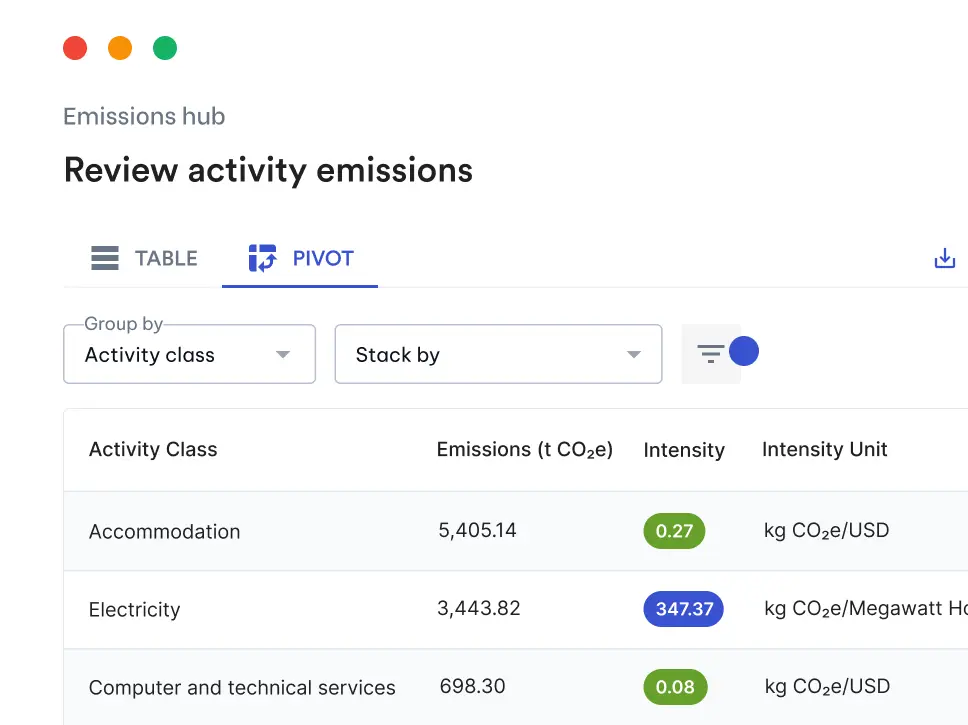
These pathways need to be prioritised based on emissions impact and feasibility, which is where granular data helps. By analysing emissions across operations, suppliers and customers, miners can identify hotspots, compare suppliers on carbon intensity, and work out where interventions pay off fastest. Avarni's mining industry tools support this by helping companies visualise Scope 3 emissions, assess supplier performance, and model transition scenarios.
This insight guides strategy as well as reporting. With investors and boards increasingly focused on emissions-linked performance, a clear, data-backed decarbonisation roadmap is fast becoming a baseline expectation.
Solving the supplier data challenge
For mining companies, Scope 3 emissions are as hard to see as they are to reduce. Most of it sits with suppliers and subcontractors, many of whom lack the systems or capacity to track their own carbon footprint. That makes supplier engagement one of the toughest and most critical parts of ASRS-aligned reporting.
Manual data collection methods like spreadsheets and email surveys don't scale across a global supply chain. They're time-consuming, inconsistent and prone to gaps. Under ASRS, companies are expected to disclose material Scope 3 emissions using the best available data, and estimates aren't enough where better data exists somewhere in the chain. Regulators, investors and customers are increasingly expecting primary emissions data wherever possible.
Avarni's supplier engagement capability gives mining companies a scalable, automated way to collect emissions data directly from suppliers, regardless of where they sit in the value chain or their carbon maturity. Suppliers receive guided, easy-to-complete requests, helping them report data in a way that aligns with your reporting requirements and the GHG Protocol.
This data integrity matters for both compliance and credibility. Once supplier data is in, mining companies can identify emissions hotspots, benchmark supplier performance, and work with vendors on targeted reductions, turning reporting into action.
Building a competitive edge through climate leadership
Customers and investors are already rewarding miners that can demonstrate low-carbon products and responsible supply chains, and this trend will accelerate as global carbon markets mature.
Miners that provide transparent emissions data and credible transition plans gain a clear advantage. They can secure long-term off-take agreements, participate in green finance opportunities, and navigate regulatory change with confidence.
Avarni supports miners through this transition by simplifying emissions measurement, improving Scope 3 visibility, and providing scenario analysis tools aligned with ASRS and beyond.
The mining sector has a crucial role in the net zero transition, both as a significant emitter and as the supplier of the critical minerals that power the clean energy shift. That dual role is why mining companies should treat ASRS as an opportunity to lead, not just an obligation to meet.
Frequently asked questions
What percentage of a mining company's emissions come from Scope 3?
Scope 3 emissions can make up to 95% of a mining company's total footprint, well above the 75% average across other sectors, according to the International Council on Mining and Metals (ICMM). This includes downstream processing, transportation, use of sold products, and upstream purchased goods and services.
Does ASRS apply to mining companies in Australia?
Yes. ASRS (AASB S2) applies to large mining companies that meet the relevant reporting thresholds under the Corporations Act, requiring disclosure of climate governance, strategy, risk management, and Scope 1, 2 and 3 emissions.
How does ASRS relate to the Safeguard Mechanism?
The Safeguard Mechanism, administered by the Clean Energy Regulator, caps Scope 1 emissions for facilities emitting more than 100,000 tCO2-e a year, including many mine sites. ASRS is broader, covering governance, strategy, scenario-based risk assessment and Scope 1, 2 and 3 disclosure. Meeting Safeguard Mechanism obligations doesn't automatically satisfy ASRS requirements.
How can mining companies collect Scope 3 supplier data at scale?
Manual methods like spreadsheets and email surveys don't scale across global supply chains. Automated supplier engagement platforms, such as Avarni, send guided data requests directly to suppliers and align responses with the GHG Protocol, replacing estimates with primary data over time.
Summary
- The unique emissions profile of mining: Scope 3 dominates a miner's emissions profile, reaching up to 95% of the total according to ICMM, and is the hardest category to measure and reduce.
- ASRS reporting: risks and requirements: ASRS (AASB S2) requires disclosure of governance, material emissions across all scopes, climate resilience and transition plans, and goes further than the existing Safeguard Mechanism.
- Turning disclosure into decarbonisation: Accurate data lets miners prioritise decarbonisation levers like haul truck electrification and renewable energy, guided by supplier and operational hotspot analysis.
- Solving the supplier data challenge: Manual data collection doesn't scale. Automated supplier engagement, like Avarni's, replaces estimates with primary data and builds audit-ready disclosures.
- Building a competitive edge through climate leadership: Miners with transparent emissions data and credible transition plans gain an edge in off-take agreements, green finance and regulatory confidence.
- Frequently asked questions: Scope 3 covers up to 95% of a miner's emissions, ASRS applies to large mining companies under the Corporations Act, ASRS extends beyond the Safeguard Mechanism's Scope 1 cap, and supplier data is best collected through automated engagement rather than spreadsheets.
By treating ASRS as an opportunity rather than a compliance obligation, mining companies can strengthen investor trust, protect market access, and build a credible path through the transition to net zero.
Originally published: 11/26/2025