Australia's food and beverage producers are now working through the same mandatory climate reporting requirements as the rest of the economy. ASRS (the Australian Sustainability Reporting Standards) is the mandatory climate disclosure framework issued by the Australian Accounting Standards Board as AASB S2, closely modelled on the ISSB's IFRS S2 standard.
For CFOs and finance leaders in food and beverage manufacturing, ASRS adds a new layer of rigour to an already complex operating environment. Emissions in this sector sit across farms, cold chains, packaging suppliers and co-manufacturers, most of which the reporting entity does not directly control.
What does ASRS require of food and beverage producers?
ASRS requires food and beverage producers that meet the reporting thresholds to disclose Scope 1, 2 and material Scope 3 emissions, climate governance, risk management and transition plans, in a phased rollout that began for the largest reporting entities in the 2025 financial year. Disclosures are prepared under the same Corporations Act obligations as financial statements, so boards and auditors hold them to the same standard.
For food and beverage producers, Scope 3 is where most of the reporting burden sits. Agricultural inputs, packaging materials, co-packing arrangements and outbound logistics typically account for the majority of a producer's footprint, and these sources sit several tiers back in the supply chain, which makes them harder to measure and defend under audit.
Boards and auditors expect these disclosures to be prepared with consistent methodology, documented assumptions and a clear audit trail. Spreadsheet-based estimates built on industry averages won't hold up to that level of scrutiny, particularly as ASIC's regulatory guidance sharpens its focus on data quality.
Why are agricultural and farm-gate emissions the hardest data problem?
Agricultural and farm-gate emissions are hard to measure because they originate upstream with growers whose practices, inputs and reporting capability vary widely by region and season. Farm-gate emissions are the emissions generated in growing and producing raw agricultural inputs, such as livestock, crops and fertiliser use, before those inputs leave the farm for processing.
Getting this data wrong in either direction carries risk. Understating emissions exposes a company to greenwashing scrutiny, while relying on overly conservative industry averages can mask real opportunities to work with lower-emission suppliers. Platforms built for this problem, like Avarni, apply activity-based and supplier-specific data to farm-gate and agricultural input emissions instead of defaulting to blunt industry averages, giving finance and sustainability teams a more defensible basis for disclosure.
Cold chain and refrigerant emissions are easy to underreport
Cold chain and refrigerant emissions are commonly underreported because they are spread across many sites and pieces of equipment that don't show up cleanly on a single energy bill. Fugitive emissions are unintentional leaks of refrigerant gases from cooling and storage equipment, and they sit within Scope 1 alongside energy-related Scope 2 emissions from the same infrastructure.
Refrigeration and cold storage run through processing, distribution and retail, so these emissions accumulate across every stage of the chain, including third-party facilities where a company may not own the equipment but still needs visibility into its performance.
Under ASRS, gaps like this are a control weakness, not a minor omission. A credible emissions baseline needs to capture fugitive emissions and energy use consistently across every site, and platforms that automate this measurement reduce the risk of material omissions reaching the final audit and assurance process.
Packaging, co-packers and supply chain data need to be consolidated
Packaging, ingredient and co-packer emissions need to be consolidated into a single data source because they are scattered across suppliers, formats and regions in a typically fragmented supply chain, and multiple product lines and export markets add further complexity.
This is where supplier engagement becomes central to ASRS compliance. Reporting entities need a scalable way to collect primary emissions data from growers, co-packers and packaging suppliers, rather than relying on estimates alone. Avarni's supplier engagement capability integrates procurement and supplier data into one system, closing gaps through structured supplier requests rather than ad hoc spreadsheets and email chains.
Retailers are pushing scope 3 requirements down the supply chain
Major grocery retailers are increasingly requiring their suppliers to provide emissions data as a condition of doing business, which means food and beverage producers face reporting pressure from their largest customers as well as from regulators.
This dynamic raises the commercial stakes of getting carbon accounting right. Producers that can supply transparent, audit-ready emissions data to retail partners are better placed to protect shelf space and pricing terms. Those that cannot will face increasing friction in retailer negotiations, regardless of their ASRS obligations.
How can a carbon accounting platform turn ASRS compliance into commercial insight?
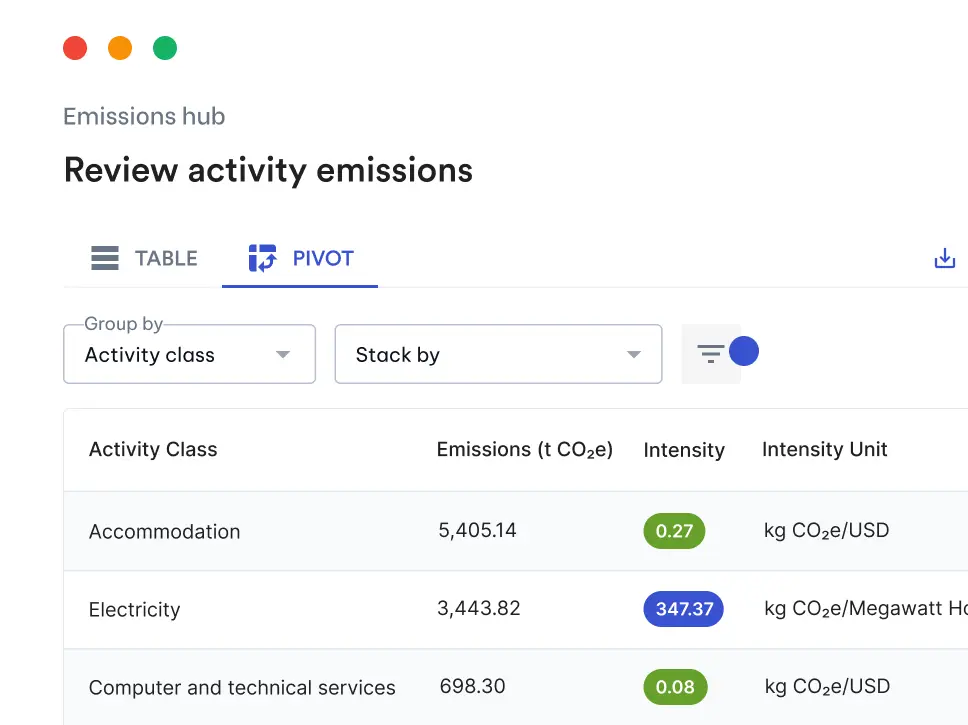
A carbon accounting platform turns ASRS compliance into commercial insight by automating emissions calculations across the supply chain and surfacing the underlying data for sourcing and product decisions, not just for disclosure. Avarni supports food and beverage manufacturers, including Kagome and Teys, in managing Scope 1 to 3 emissions across supply chains, processing facilities and cold chain logistics, using up-to-date emission factors and logging every input and assumption to support audit-ready, ASRS-aligned reports.
Beyond compliance, this data has direct commercial value. Identifying high-emission ingredients, packaging formats and suppliers early gives finance and procurement teams a basis for reformulation and sourcing decisions, and supports the development of lower-carbon product lines as retailers and consumers pay closer attention to product-level emissions.
Automating this process also reduces the cost of compliance itself: manual, spreadsheet-based emissions tracking is slow, error-prone and difficult to scale across multiple sites and product lines. Learn more about Avarni for food and beverage production or talk to a specialist about your reporting obligations.
FAQ
What is ASRS?
ASRS stands for the Australian Sustainability Reporting Standards, the mandatory climate disclosure framework issued by the AASB as AASB S2, based on the ISSB's IFRS S2 standard.
Does ASRS apply to food and beverage companies?
Yes. Any food and beverage producer that meets the size and revenue thresholds set out in the Corporations Act is required to prepare a sustainability report alongside its financial statements, with obligations phased in across three cohorts from 2025 to 2027.
What are the biggest sources of emissions in food and beverage production?
The largest sources are typically Scope 3: agricultural and farm-gate inputs, packaging materials, co-packing arrangements and outbound logistics. Cold chain refrigerant and energy use also contribute meaningfully to Scope 1 and 2 emissions.
Why is Scope 3 data harder to collect in this sector?
Scope 3 emissions sit several tiers back in the supply chain, with growers, co-packers and packaging suppliers who often lack the systems or capacity to measure and report their own emissions.
How can a carbon accounting platform help with ASRS compliance?
A platform like Avarni automates emissions calculation from farm-gate inputs, packaging and cold chain data, engages suppliers to close Scope 3 data gaps, and produces audit-ready reports aligned with ASRS.
Summary
- ASRS requires food and beverage producers to disclose Scope 1, 2 and material Scope 3 emissions, governance arrangements and transition plans, with the same rigour expected of financial reporting.
- Agricultural and farm-gate emissions are the hardest to measure, given variability across growers, regions and seasons, and require activity-based, supplier-specific data rather than industry averages.
- Cold chain and refrigerant emissions are commonly underreported and need consistent measurement across every site, including third-party facilities.
- Packaging, ingredient and co-packer emissions are scattered across a fragmented supply chain and need to be consolidated into a single, auditable data source.
- Major retailers are pushing Scope 3 reporting requirements onto suppliers, adding commercial pressure alongside regulatory obligations.
- A platform like Avarni automates emissions calculation and supplier data collection, supporting ASRS-aligned disclosure while surfacing insights that inform sourcing and product decisions.