Retail is one of the most exposed sectors under the Australian Sustainability Reporting Standards (ASRS). Retailers sit between manufacturers, brands and consumers, so their emissions footprint spans thousands of products, hundreds of suppliers and often hundreds of physical stores. For CFOs and finance leaders, ASRS turns that complexity into a reporting obligation with legal and financial consequences.
Retail businesses must disclose Scope 1, 2 and Scope 3 emissions, governance arrangements, climate risk assessments and transition plans under AASB S2. Most of a retailer's footprint sits in purchased goods, so Scope 3 carries the bulk of the reporting burden. This article covers what ASRS requires of retailers, where the reporting challenges sit, and how a carbon accounting platform like Avarni supports compliance.
What does ASRS require of retailers?
The ASRS, developed by the Australian Accounting Standards Board and set out in AASB S2, mandates climate-related financial disclosures for large Australian entities. Retailers captured by the standard must report material climate risks and opportunities, emissions across all three scopes, and the governance processes overseeing this work.
These disclosures sit alongside financial statements and face the same scrutiny from boards, auditors and investors. ASIC has signalled it will pursue greenwashing claims where net zero statements are not backed by verifiable data. For retailers, that raises the bar on data quality well above what voluntary ESG reporting required.
Where do retail emissions actually sit?
Product and merchandise emissions dominate the footprint for most retailers. Purchased goods span thousands of SKUs across categories, brands and manufacturing origins, and each carries its own embedded emissions from raw materials, manufacturing and freight. This category typically represents the largest share of a retailer's total emissions, well ahead of store energy use or logistics.
Store networks and distribution centres add a second layer of emissions. Electricity, refrigeration and HVAC across dozens or hundreds of sites need to be tracked consistently, store by store, to build a reliable operational baseline. Franchise and licensing arrangements complicate this further, since emissions data may sit with a franchisee rather than head office.
Mapping this accurately requires more than a single spreadsheet. It requires consistent data collection across stores, categories and supplier tiers, reconciled against a defensible set of emission factors.
Why do suppliers create the biggest data gap?
Supplier and brand data is the hardest part of Scope 3 reporting for retailers. Emissions are scattered across hundreds, sometimes thousands, of suppliers, brands and private label manufacturers, many of which have limited capacity to measure or report their own emissions, particularly smaller or offshore manufacturers.
Manual approaches, such as spreadsheet templates and email requests, do not scale across a supplier base this size. They are slow, inconsistent, and leave gaps that get filled with estimates. The GHG Protocol's Scope 3 Standard expects companies to use the best available data and disclose the limitations of estimates, so gaps need to be identified and closed systematically rather than papered over.
Platforms like Avarni address this by engaging suppliers directly through structured, guided data requests aligned with the GHG Protocol. This consolidates supplier and brand data into a single source of truth, closing gaps at scale rather than chasing individual suppliers for one-off reports.
How can retailers turn disclosure into decision-useful data?
Emissions data is most valuable when it shapes sourcing, merchandising and store investment decisions. For retailers, that means identifying which product categories, suppliers or store formats drive the largest share of emissions, then acting on that information.
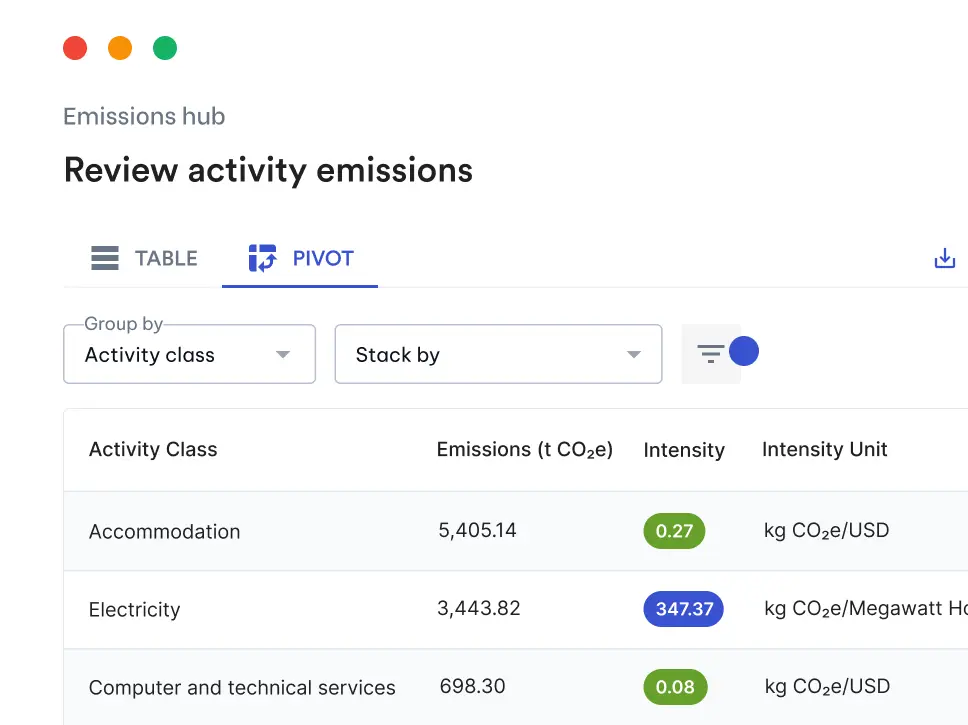
Avarni supports this by calculating emissions with AI, mapping procurement and store data against emission factors to surface hotspots across product ranges and supplier tiers. From there, retailers can model reduction scenarios and prioritise interventions based on impact, rather than relying on broad industry averages.
This level of detail also supports procurement negotiations and supplier scorecards, giving retailers a defensible basis for choosing lower-carbon suppliers and product ranges.
How does enterprise complexity affect ASRS reporting?
Many retail groups operate multiple banners, formats and geographies, sometimes with franchise or licensing structures layered on top. Each of these adds a reporting boundary that needs to be defined and consistently applied. A retailer with owned stores, franchised locations and an online marketplace needs one consistent methodology that holds up across all three.
Avarni handles this through custom mapping and emission factors tailored to each part of the business, producing ASRS-aligned disclosures across governance, strategy, risk management, and metrics and targets, regardless of how the underlying business is structured.
Why does audit-readiness matter now?
ASRS disclosures need to withstand scrutiny from regulators, auditors and increasingly customers. Every input, assumption and calculation needs to be logged and traceable, not held in someone's head or buried in a spreadsheet formula.
This is where many retailers currently fall short. Legacy processes built for voluntary reporting were not designed for audit. Avarni logs every input and assumption behind a calculation, giving finance and sustainability teams a defensible, audit-ready record as assurance requirements tighten over coming reporting cycles.
Learn more about Avarni for retail or talk to a specialist about your reporting obligations.
Frequently asked questions
Does ASRS apply to retail businesses?
Yes. Retailers that meet the size thresholds under the Corporations Act, based on revenue, gross assets or employee numbers, must comply with AASB S2 climate disclosure requirements, regardless of industry.
What's the biggest Scope 3 challenge for retailers?
Collecting reliable emissions data from suppliers and brands across thousands of SKUs. Most suppliers lack the systems to report emissions on their own, which is why structured supplier engagement matters more than the calculation method itself.
Do franchised stores need to report separately under ASRS?
Franchise and licensing arrangements need a clear, consistent reporting boundary. In most cases, the parent entity is responsible for the group's disclosure, but emissions data still needs to be sourced from each franchisee.
What happens if a retailer's disclosures aren't audit-ready?
Reporting entities risk failing assurance, regulatory action from ASIC, and reputational damage from greenwashing claims. AASB S2 disclosures sit alongside financial statements and are scrutinised the same way.
Summary
- ASRS applies fully to retail: retailers must disclose Scope 1, 2 and 3 emissions, governance arrangements and transition plans, with the same scrutiny applied to financial statements.
- Product and merchandise emissions dominate: purchased goods across thousands of SKUs and suppliers typically represent the largest share of a retailer's footprint.
- Store networks add operational complexity: electricity, refrigeration and HVAC across large store and distribution networks need consistent, site-level tracking.
- Supplier engagement is the biggest data gap: manual collection methods do not scale, and platforms like Avarni close gaps through structured, GHG Protocol-aligned supplier requests.
- Data should drive commercial decisions: hotspot analysis across products, suppliers and stores supports sourcing and merchandising decisions.
- Enterprise structure needs a consistent methodology: multiple banners, formats and franchise arrangements require tailored mapping to produce coherent ASRS disclosures.
- Audit-readiness is now baseline: every input and assumption needs to be logged and traceable to withstand regulator, auditor and investor scrutiny.